






Dave's 16 Inch Binocular Telescope Page








Eye spacing varies greatly between different observers, therefore there must be a some mechanism by which the intraocular distance can easily be adjusted. The interpupillary distance ranges from roughly 53 to 73 millimeters with an average IPD for the adult population of approximately 63 millimeters. One of the restrictions that this presents is that it is almost impossible to use 2 in. eyepieces. Therefore my design only uses 1 1/4 inch eyepieces.
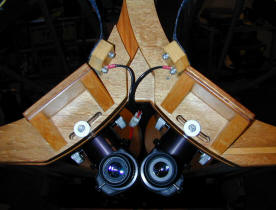
There are two main systems that have been employed in order to alter the interocular distances. The first system involves to focuser type mechanisms to push the eyepieces closer together or farther apart, focus is then being achieved either by moving the eyepiece up and down or in the case of JMI moving the entire secondary and focus a mechanism vertically in unison. The main problem with this design is that every time the interocular distance is changed the focus is also changed by a similar amount.
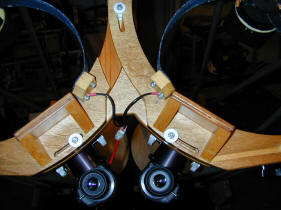
The second approach, which is the approach that I have chosen involves using a rotating secondary cage. This causes the eyepieces, focusers and secondaries of the two different optics paths to rotate farther apart or closer together to each other. With this approach the focus is consistent regardless of the interocular spacing. And focus is achieved with a standard focus a mechanism.
Looking at the photographs you will
see that I have used a reasonably complex system of slots in the upper ring with
Teflon bushes allowing the rotation to happen. Upon reflection this is
probably far too complicated for the task at hand and a much more simplistic
design will be used to allow the tops to rotate in any future design. firstly
the rings would have been much farther apart so as not to need the complex
overlapping system. This was only done as I was trying to reduce the
overall dimensions of the width of the telescope, however I believe this was
unnecessary. The slots could easily be replaced with simple blocks placed
on either the inside or the outside of the ring system again with Teflon
Barings.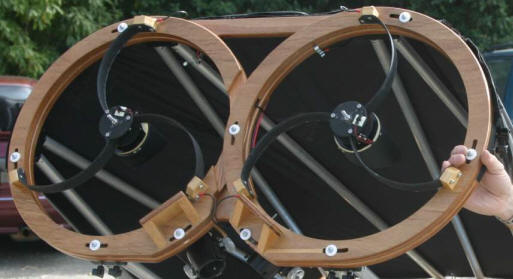
In practice this approach so far seems to work very elegantly. Only small horizontal and vertical shifts have been noticed while changing the interocular spacing and most people naturally tend to try and move the eyepieces apart or closer together as they would with a standard pair of binoculars. This is a very intuitive mechanism that is a pleasure to use.